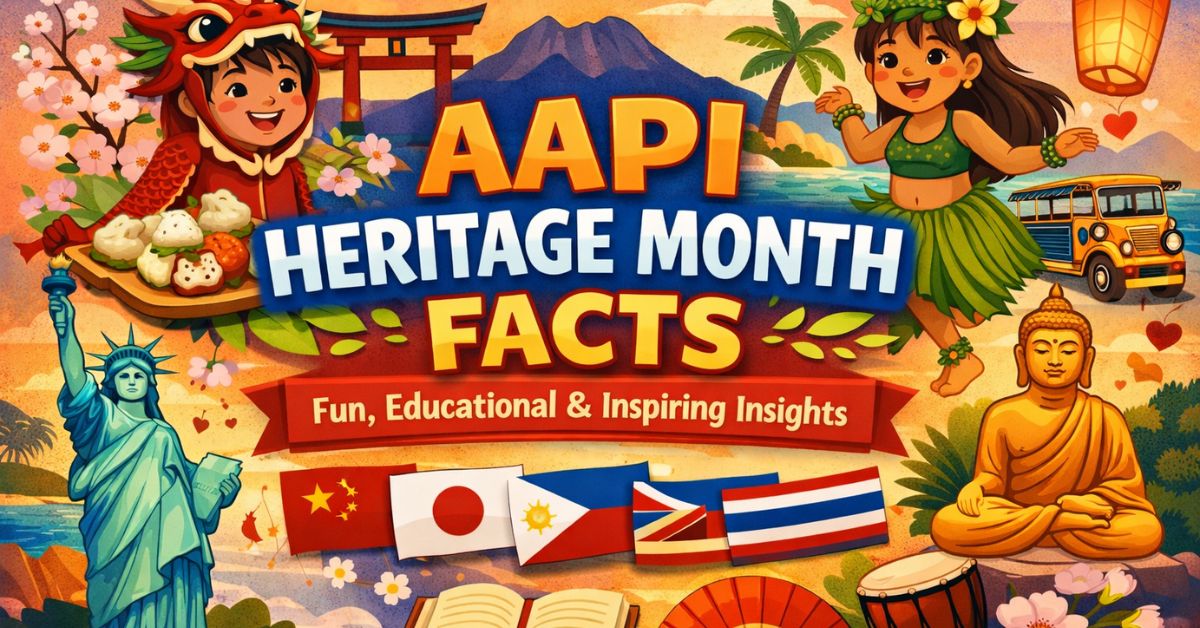
AAPI Heritage Month Facts
Step into a bustling night market: the air is heavy with the scent of grilled chicken satay, the sweetness of mango sticky rice floats by, and you can almost hear the pounding beat of taiko drums somewhere in the distance. Bright silk fabrics ripple in the breeze, and everywhere you look, someone’s sharing a story, an old tradition, a new flavor, or a piece of their world.
That’s the spirit of Asian American and Pacific Islander (AAPI) Heritage Month energy, history, and pride rolled into one. Every May, we celebrate this incredible community. Maybe you’re here looking for AAPI Heritage Month facts, searching for fun tidbits for your kid, or hoping for a little inspiration. No matter what brought you here, take a breath; you’re in the right spot.
So, let’s take a walk through what this month means. We’ll dive into its history, check out some jaw-dropping firsts, and see why this is way more than just flipping your calendar to May. It’s about recognizing the folks who didn’t just watch history; they shaped it.
What Is AAPI Heritage Month? (History, Meaning & Origins)
Let’s talk about May. Why do we celebrate AAPI Heritage Month now? May isn’t a random pick off the calendar. It’s a month packed with history.
AAPI Heritage Month honors the lives, cultures, and contributions of Asian Americans and Pacific Islanders across the United States. The AAPI label covers a ton of people from every corner of Asia (East, Southeast, and South) and Pacific Islands like Melanesia, Micronesia, and Polynesia. Dozens of countries, hundreds of languages, and a few thousand years of stories.
And about the timing, two moments stand out in May:
- The first Japanese immigrants arrived on May 7, 1843.
- The transcontinental railroad, built in large part by Chinese immigrants, wrapped up on May 10, 1869.
Why AAPI Heritage Month Matters in the U.S.
Some people ask, Why do we need a whole month? Easy: because representation matters. When kids see scientists, athletes, and artists who look like them, they get to believe it’s possible for them, too. This month lifts stories you don’t always find in textbooks.
It also shows just how diverse this community is. There’s no single AAPI culture. Someone from Samoa and someone from India bring completely different traditions. Celebrating together helps us notice the beautiful differences, along with shared values like resilience and hard work.
And, honestly, it’s a chance to say thanks. Whether you’re sending a text or picking up a prescription, AAPI individuals shaped those parts of your life. This month is a thank-you note.
AAPI Heritage Month Facts: 20 Key Facts & Milestones
All right, here’s what you came for: 20 facts and milestones from AAPI history and culture to make you the smartest one in the room.
History and Firsts in AAPI Heritage
- It started small: A single week in 1978, thanks to President Jimmy Carter. By 1992, Congress turned it into a month.
- Dalip Singh Saund, from India, was the first Asian American in the U.S. Congress way back in 1957.
- Patsy Mink (from Hawaii) was the first woman of color in Congress in 1964. She helped push for Title IX, making sports fairer for women everywhere.
- In 2021, Kamala Harris broke barriers as the first female, first African American, and first South Asian American Vice President of the U.S.
- Duke Kahanamoku from Hawaii won five Olympic swimming medals and is known as the Father of Modern Surfing.
Science and Innovation Contributions
- Chien-Shiung Wu, called the Queen of Physics, helped crack the problem of beta decay and worked on the Manhattan Project.
- Two of YouTube’s founders, Steve Chen and Jawed Karim, are AAPI. Without them, no endless cat video marathons.
- Ajay Bhatt, born in India, led the team that created the USB. Think about that the next time you charge your phone.
- Dr. David Ho led life-saving AIDS research and was Time Person of the Year in 1996.
Culture and Arts Highlights
- Anna May Wong, Hollywood’s first Chinese American movie star, paved the way. In 2023, Michelle Yeoh became the first Asian woman to win Best Actress at the Oscars.
- Maya Lin wasn’t even out of college when she designed the Vietnam Veterans Memorial in DC.
- Yo-Yo Ma has 19 Grammy Awards under his belt and uses his cello to connect cultures around the globe.
- Amy Tan’s novel, The Joy Luck Club, opened up Chinese American family stories to the world.
Surprising and Fun AAPI Facts
- Hula is more than a dance; it’s how Native Hawaiians tell their history and legends.
- The Mother of Exiles poem sits at the Statue of Liberty, but the first Asian immigrant entered through Angel Island in 1910, America’s Ellis Island of the West.
- Hawaii eats more Spam per person than anywhere else. It got popular during WWII and never left the menu.
- Yoga, now a fitness craze, began in ancient India as both a spiritual and physical practice.
- Ancient China invented paper around 105 AD. Next time you jot down a note, thank them.
Fun AAPI Heritage Month Facts for Kids
Hey, kids, check this out!
- Some say the ice cream cone got its boost from a Syrian immigrant at the 1904 World’s Fair.
- Tons of your favorite cartoons and movies come from brilliant AAPI animators and directors.
- Karate, Taekwondo, and Kung Fu all started in Asia as ways to grow strong and disciplined.
- If you stretched the Great Wall of China straight, it would wrap almost halfway around the Earth.
- Pacific Islanders were genius sailors, navigating for thousands of miles using just stars, waves, and birds.
How People Celebrate AAPI Heritage Month
This month isn’t just about lists (even though, yeah, lists are fun). It’s about action and joy, and there are so many ways to jump in.
1. Food and Cultural Cuisine Experiences
There’s no more delicious way to connect than food. Try Ube bread from a Filipino bakery, a steaming bowl of pho, or a classic Hawaiian poke. And if there’s an AAPI-owned spot in your neighborhood, go say hi and grab a bite.
2. Festivals, Parades, and Cultural Events
Cities throw cultural festivals, from dragon boat races to Diwali lights to cherry blossom parades. Even if the big event isn’t in May, a lot of groups launch their celebrations now.
3. School and Library Activities
Libraries feature books by AAPI authors; go look for graphic novels by Gene Luen Yang or pick up Mindy Kaling’s memoir. Schools might have guest speakers, art projects, or share-and-tell days to spotlight all the different heritages.
4. Learning Through Movies and Media
Maybe watch a documentary or a movie that brings AAPI stories to life, like Moana, Minari, or Crazy Rich Asians.
Final Thoughts: Why AAPI Heritage Month Still Matters Today
One last thing, AAPI Heritage Month shouldn’t just live in May. The stories, inventions, and art from Asian Americans and Pacific Islanders are all around us, every day.
Next time you use some cool new tech, admire a stunning building, or just sit down for a great meal, give a moment of thanks to the diverse hands and minds who made it happen.
Hope these facts left you a little more curious, a little more grateful, and a little more connected to your world. Let’s stay curious, keep celebrating, and always appreciate the cultures that brighten up our communities.
Happy AAPI Heritage Month!
Want to dig deeper? Stop by your library for some AAPI staff picks, or bring up your favorite fact next time you see a friend. And if there’s an AAPI-owned business or tradition you love, drop a comment below. I’d love to hear your story!
Frequently Asked Questions (FAQs)
1. What is AAPI Heritage Month?
AAPI Heritage Month is celebrated every May in the United States to honor the history, culture, and contributions of Asian Americans and Pacific Islanders.
2. Why is AAPI Heritage Month celebrated in May?
May was chosen to mark two important events: the arrival of the first Japanese immigrants on May 7, 1843, and the completion of the transcontinental railroad on May 10, 1869.
3. What does AAPI stand for?
AAPI stands for Asian American and Pacific Islander, a term that includes people with roots in Asia and the Pacific Islands.
4. Why is AAPI Heritage Month important?
It highlights the achievements, culture, and impact of AAPI communities, while also promoting diversity, inclusion, and representation.
5. What are some interesting AAPI Heritage Month facts?
Some interesting facts include the creation of YouTube by AAPI founders, the invention of paper in ancient China, and the influence of AAPI individuals in science, arts, and politics.
6. What are some AAPI Heritage Month facts for kids?
Kids can learn that martial arts like karate and taekwondo originated in Asia, Pacific Islanders were expert navigators, and many popular foods and traditions come from AAPI cultures.
7. How can people celebrate AAPI Heritage Month?
People celebrate by attending cultural events, trying AAPI cuisines, supporting AAPI-owned businesses, reading books, and learning about AAPI history.
8. Who are some famous AAPI figures?
Notable figures include Kamala Harris, Yo-Yo Ma, Maya Lin, and Michelle Yeoh, who have made significant contributions in their fields.
9. When did AAPI Heritage Month start?
It began as a week-long celebration in 1978 and was expanded to a full month in 1992.
10. Where can I learn more about AAPI culture and history?
You can explore libraries, museums, documentaries, and online resources that focus on Asian American and Pacific Islander stories and achievements.