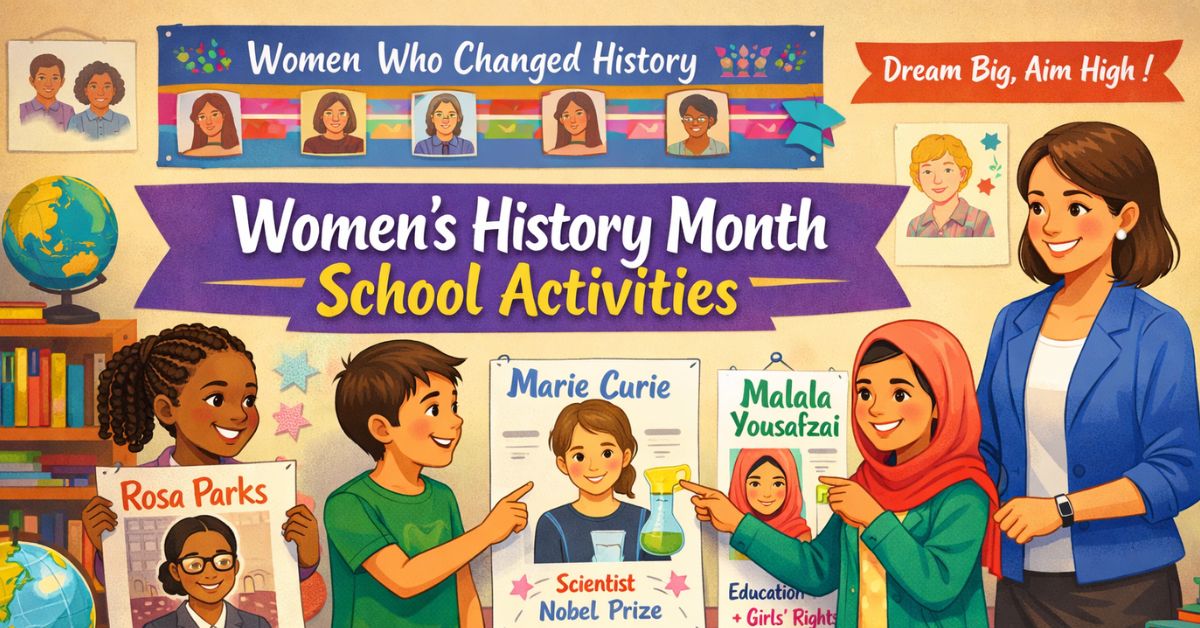
Women’s History Month school activities
Imagine it’s early March. The halls aren’t lined with the same old lockers and faded posters. Instead, you walk in and see the walls bursting with color and history. There’s a hand-drawn portrait of Rosa Parks right next to a student’s essay on civil rights. Further down, a galactic wall sparkles with stories about Katherine Johnson’s math that sent astronauts to the moon. In a third-grade classroom, a bunch of kids crowd around a tablet, listening to Malala Yousafzai’s Nobel Peace Prize speech.
That’s what happens when history feels real instead of something you just read about. Women’s History Month isn’t just another curriculum box to tick. It’s a chance to show every student, girls and boys, that breaking barriers matters and leadership can look a hundred different ways.
Why Do Schools Celebrate Women’s History Month?
Let’s be honest, history books haven’t always given women the spotlight. March gives teachers a chance to change that. It’s not just about the same few famous names, either. Schools get to dig into the stories of scientists, athletes, activists, and artists, real people who shaped the world we live in.
Bringing these stories into the classroom isn’t just about sharing facts. It’s about teaching leadership, equality, and grit. Girls start to see themselves as inventors, leaders, and pioneers. Boys learn to respect and value the women around them. Everybody wins.
A few women who always make an impact:
Rosa Parks: More than just a bus seat. Her story shows what quiet, steady courage can do.
Marie Curie: She faced down obstacles, physical exhaustion, and society’s doubts and still changed science forever.
Malala Yousafzai: She fought for the right to go to school. Students get it. They’re sitting in those seats now.
Creative Women’s History Month Activities for Schools
Want to make Women’s History Month really stick? Get students involved. Here are some ideas:

1. The Living Hallway Timeline
Skip the textbook. Turn the hallway into a walk-through timeline. Each grade picks an era: the suffrage movement, the space race, or modern tech. They create displays or decorate doors to showcase the era’s trailblazing women.
2. Poster Projects
Let students pick a woman they admire, maybe someone less well-known like Chien-Shiung Wu, the First Lady of Physics, or Wilma Mankiller, the first female principal chief of the Cherokee Nation. They design posters that spotlight three game-changing moments in her life.
3. Storytelling and Read-Alouds
Younger kids love a good story. Set up Guest Reader days where parents or local women read biographies from series like Little People, Big Dreams.
4. Essay and Speech Competitions
Middle and high schoolers can write letters to their heroes, explaining how that woman’s life shapes their own. Or mix things up with a poetry slam where students perform original work about equality and empowerment.
School-Wide Programs That Bring Everyone Together
Sometimes, the best lessons happen outside the classroom.
Guest Speakers from the Community
Invite women who are making a difference, firefighters, judges, engineers, and business owners to talk about their work and the obstacles they’ve faced. Students get to see real-life role models, not just names in a book.
Assemblies That Celebrate Pioneers
Host a Women in Action assembly. Make it fun: short videos, music, and student skits that follow the story of women’s rights.
Documentary Screenings
Try a lunch and learn. Show documentaries like Hidden Figures or He Named Me Malala, then open the floor for a real conversation about what those stories mean today.
Women’s History Month isn’t just about looking back. It’s about helping students see what’s possible right now.
Virtual Museum Tours
If a field trip isn’t in the cards, don’t sweat it; go digital. A lot of museums, like the National Women’s History Museum, have fantastic virtual tours you can check out from anywhere. Schools often team up with groups like the National Women’s History Alliance to find ready-made resources and themes that actually fit what students are supposed to be learning.
Fun Student Projects for
Women’s History Month School Activities
This is where things get interesting. Let students dive into history with hands-on projects that make it real:
Student-Created Podcasts: Have kids pair up, with one serving as the interviewer and the other as the historical figure they’ve researched. It’s a creative, tech-friendly way to explore someone’s life story.
Biography Presentations (The Wax Museum): Picture this, students dress up as famous women, stand frozen in the gym, and come to life to give a quick speech when someone presses their button. It’s part acting, part history lesson, and all fun.
History Exhibitions: Transform the library into a pop-up museum. Students bring in or make artifacts, such as a hand-built model of Amelia Earhart’s plane, and write up museum-style labels to explain what they made and why it matters.
Global Leaders Research: Break students into groups and have each group research a woman leader from a different region, such as Ellen Johnson Sirleaf of Liberia or Jacinda Ardern of New Zealand. It’s a great way to make sure students see the bigger picture.
How Teachers Can Make the Celebration Stick
If you want Women’s History Month to mean something, here are a few things that help:
Connect to Now: Don’t just stick to the past. Talk about women making waves today in climate action, AI, sports, you name it.
Get Students Talking: Ask questions that make them think. How would our world look if [Name] hadn’t spoken up? Let them wonder aloud.
Show All Kinds of Women: Make sure your lessons spotlight women of every race, religion, ability, and background. Intersectionality isn’t just a buzzword; it matters if you want everyone to feel included.
Make It Fun: Use tools like Kahoot or Quizizz to create trivia games on women’s history. A little friendly competition goes a long way.
Final Thoughts
Women’s History Month isn’t just about looking back; it’s about giving students the spark to dream big. When kids learn about Marie Curie’s determination or Malala’s courage, they start to see that same fire in themselves. By weaving these stories into our lessons, we don’t just teach history; we help shape the next wave of trailblazers.
Let’s make March a month where every student discovers something new about themselves and the world and leaves knowing their voice really can make a difference.
FAQ Section
What are some easy Women’s History Month school activities?
Start simple: have students draw a Wall of Fame with portraits of inspiring women, do a themed read-aloud with books about trailblazers, or add some women’s history trivia to your morning announcements.
Why is Women’s History Month important for students?
It gives kids a fuller picture of history, highlights gender equality, and puts diverse role models front and center. It also gets them thinking about social justice and what it means to be a leader.
How can teachers celebrate Women’s History Month in the classroom?
Teachers can weave women’s achievements into every subject, like featuring female mathematicians in math or highlighting women scientists in the lab. Project-based learning, such as podcasts or living wax museums, also brings these stories to life.
What projects can students do for Women’s History Month?
Try a Living Wax Museum, digital presentations, or podcasts, or even have students design stamps or posters celebrating women who’ve changed the world.
How can I find diverse role models for my students?
Check out resources from the National Women’s History Alliance or the Smithsonian. They have archives full of stories about women from all backgrounds in STEM, the arts, politics, and activism, both here and around the globe.